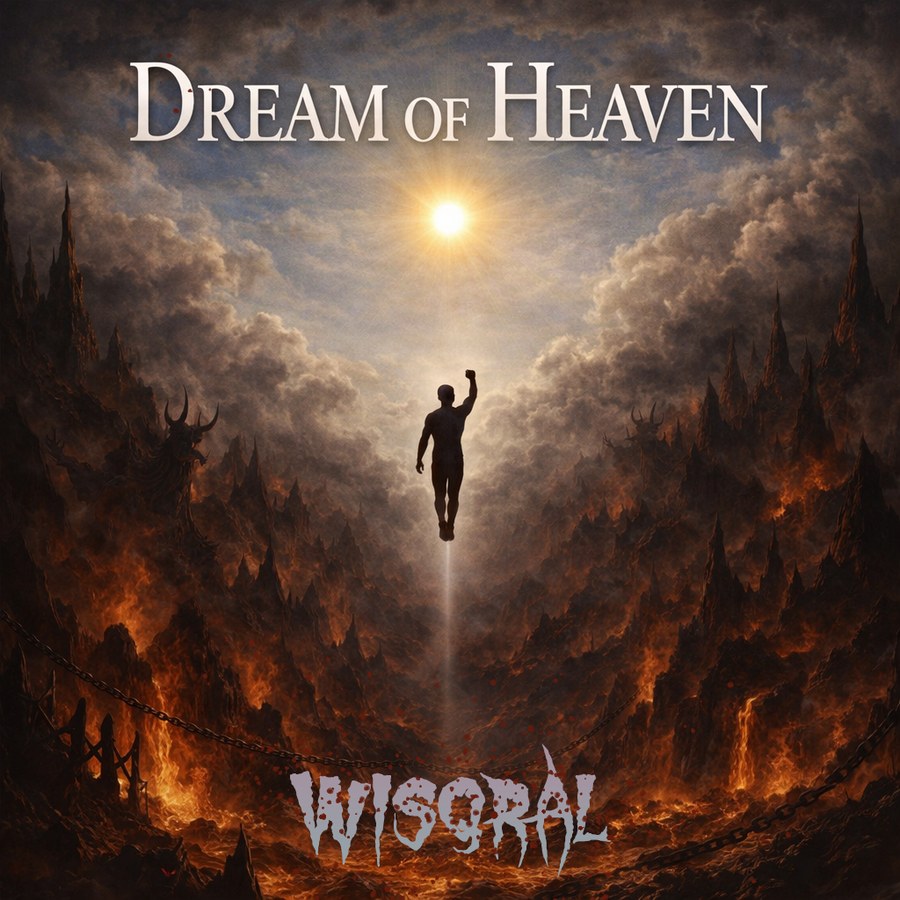
New Single · Out Now
Dream of Heaven
(Khichdi Freestyle)
Wisqral feat. Man of Wisdom
(Khichdi Freestyle)
Wisqral feat. Man of Wisdom
Would I fly in the skies?
Or would I crash and fail?
'Cause I dream of a heaven
And I come from hell.
A single quatrain frames the gap between origin and ambition with no guarantee of which way it resolves. Three verses are three different weather systems inside that gap. The song refuses to answer the question — and ends not with I'm flying but with Fly, fly, fly. The aspiration outlasts the resolution.
The line that holds the song together — प्रण है फौलाद, सर पे माँ का आशीर्वाद — translates as my vow is steel, my mother's blessing on my head. Not I'm tough enough to make it. But: the body might break — the promises I made on it are not negotiable.
Four lines stack into the song's actual argument:
Quitting is not in my gene, even when I'm on guillotine.
Ek din maut ke saudagar ko utarunga maut ke ghat.
(F*** Cancer!)
प्रण है फौलाद,
सर पे माँ का आशीर्वाद।My vow is steel; my mother's blessing on my head.
Now the nice guy is dead, and I'm breaking bad.
The chorus question — fly or crash? — is unanswerable on purpose. The body might fall. The vow continues regardless. The refrain Fly, Fly, Fly at the end is the vow flying — not the speaker. Note the absence of "I" in those lines.
| Intro | Hinglish | Aspirational + self-deprecating: "I dream of Michelin meals but right now I'm making Khichdi." |
| Verse 1 | English-dominant | Defeat → refusal-to-quit. One rhyme family — -een/-ine/-eam/-ene/-ean — sustained ~30 lines. Form mirrors content: one feeling held under pressure. |
| Verse 2 | Hindi-dominant | Grief → vow. The rhyme family pivots at Pran hai faulad — -at (grief) becomes -aad (vow). Form mirrors content: grief turning into resolve. |
| Verse 3 | Hinglish | Heartbreak → braggadocio → identity transformation. Multiple rhyme families threaded simultaneously, multiple character voices. Form mirrors content: now containing multiple selves. |
| Refrain | English | Fly, fly, fly. The only resolution the song allows. |
Stylistically: the autobiographical density of Eminem's recovery-era work, the unselfconscious code-switching of contemporary Indian hip-hop, and the multi-character verse construction associated with Kendrick Lamar. Its distinguishing move is letting genuine vulnerability share space with rhyme acrobatics — rather than choosing between them.
This is the debut. There's a vault behind it.